

Updated September 21, 2026
Quick Summary:
- Federal Tax Relief on Overtime: Under federal tax legislation, eligible hourly workers can deduct the premium portion of qualified FLSA overtime pay from their taxable income.
- Annual Deduction Cap: Workers can deduct up to $12,500 in qualified overtime pay per year (or $25,000 for married couples filing jointly).
- FLSA Overtime Qualified: Applies strictly to overtime pay required by the Fair Labor Standards Act (hours worked beyond 40 hours per workweek at time-and-a-half).
- FICA & Local Taxes Still Apply: Overtime pay is not exempt from Social Security, Medicare (7.65%), or the 1% St. Louis City Earnings Tax.
- Claiming the Deduction: Claimed on Schedule 1-A of Form 1040—available whether you take the standard deduction or itemize expenses.
- Get Expert CPA Guidance: Contact STL Tax or call our South City office on Gravois Road at (314) 645-1614 to ensure your overtime tax savings are maximized.
From trade contractors and manufacturing personnel in South County to healthcare workers in West County and hospitality staff across St. Louis City, logging extra hours beyond a 40-hour workweek is common practice.
The federal “No Tax on Overtime Pay” provision provides significant tax relief for hard-working hourly employees. However, despite headline slogans, overtime pay is not completely tax-free across all tax jurisdictions.
To help local workers and business owners navigate these tax changes, STL Tax breaks down how the federal overtime deduction works, who qualifies, and how to report overtime earnings accurately on your tax return.
1. What Is the “No Tax on Overtime Pay” Deduction?
The law establishes an above-the-line federal income tax deduction for qualified overtime pay. Rather than eliminating overtime reporting on paystubs, it allows eligible workers to deduct the overtime pay portion directly from their taxable income when filing their federal tax return.
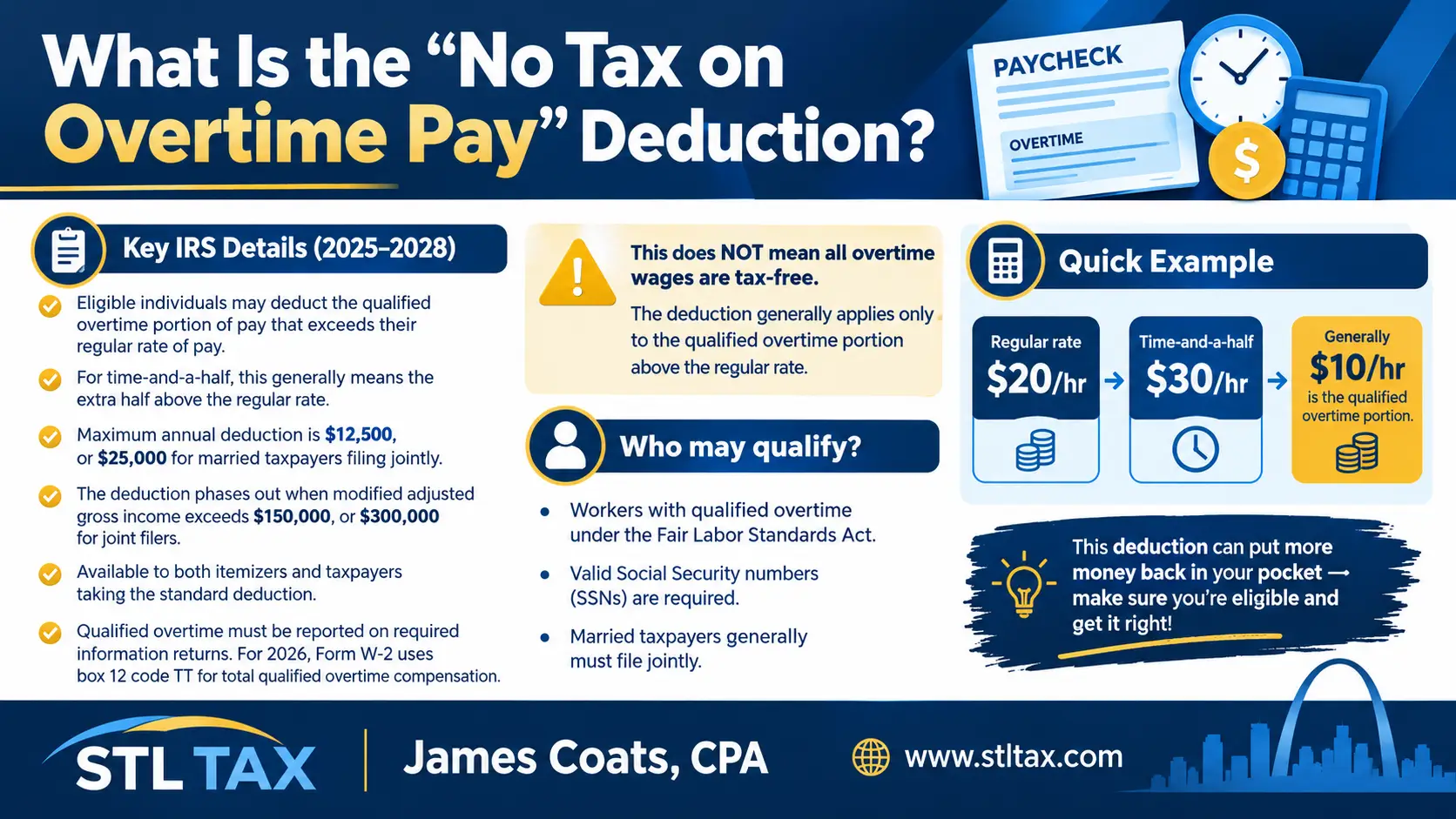
Key Caps and Income Limits:
- $12,500 Annual Cap: Single filers can deduct up to $12,500 of qualified overtime earnings per year ($25,000 for married couples filing jointly).
- Standard or Itemized Filers: You can claim this deduction regardless of whether you take the standard deduction or itemize deductions.
- Income Phase-Outs: The deduction begins to phase out for single taxpayers with Modified Adjusted Gross Income (MAGI) above $150,000 ($300,000 for joint returns).
2. What Qualifies as “Overtime Pay”?
The IRS applies strict guidelines regarding what constitutes qualified overtime pay:
- Fair Labor Standards Act (FLSA) Definition: Qualified overtime is defined as compensation received for hours worked in excess of 40 hours in a single workweek, paid at a rate not less than one and one-half times (1.5x) the employee’s regular hourly rate.
- Premium Portion Focus: The deduction specifically targets the 0.5x premium portion (or total qualified overtime wages as defined by tax guidelines) earned for working extra hours.
- Exclusions: Discretionary bonuses, holiday pay, double-time bonuses not mandated by FLSA, and exempt salaried employee bonuses do not qualify for the deduction.
3. What Taxes Do You STILL Have to Pay on Overtime?
It is critical for St. Louis workers to understand that “No Tax on Overtime” applies specifically to federal income tax.
- FICA Payroll Taxes (Social Security & Medicare): Employers are still required to withhold the standard 7.65% Social Security and Medicare taxes on all overtime earnings.
- Missouri State Income Tax: State tax treatments vary. Unless Missouri explicitly conforms its state tax code to match federal line-item additions, state income tax may still apply to gross overtime wages.
- St. Louis City Earnings Tax: If you work or live within St. Louis City boundaries, the 1% St. Louis City Earnings Tax (administered by the St. Louis Collector of Revenue) applies to all gross earned wages, including overtime.
4. How Employers & Workers Report Overtime Deductions
Proper documentation on payroll forms and tax returns is essential to ensure compliance:
- Form W-2 Updates: Employers report total qualified FLSA overtime wages in Box 12 (using Code OT) on annual W-2 statements.
- Schedule 1-A (Form 1040): When filing your annual federal income tax return, overtime deductions are calculated on Schedule 1-A (“Additional Deductions”) and transferred to Form 1040.
- Employer Payroll Systems: St. Louis business owners must ensure their payroll software (such as QuickBooks Payroll) is updated to track and report FLSA overtime pay separately in Box 12.
Real-World Case Study: St. Louis Trade Worker Tax Savings
Meet Dave: Dave works as an HVAC technician for a commercial contractor in South County St. Louis. Working emergency service calls during peak summer and winter months, Dave earned $58,000 in regular wages and $14,000 in qualified FLSA overtime pay, for a total annual wage income of $72,000.
Dave brought his W-2 statement to STL Tax.
- The Strategy: CPA James Coats reported his gross income and claimed the maximum $12,500 qualified overtime deduction on Schedule 1-A.
- The Result: Dave’s federal taxable income dropped significantly, saving him over $1,500 in federal income taxes and increasing his annual refund check.
Maximize Your Overtime Tax Deductions with STL Tax
Putting in extra hours on the job should reward you, not push you into a higher tax burden without relief. Working with experienced local tax professionals ensures every eligible deduction is claimed accurately.
At STL Tax, led by CPA James Coats, we specialize in individual tax preparation, small business payroll services, and IRS tax resolution for workers and employers across Greater St. Louis.
Call our St. Louis office today at (314) 645-1614 or schedule your tax preparation consultation online.
